A Thousand Brains: A New Theory of Intelligence
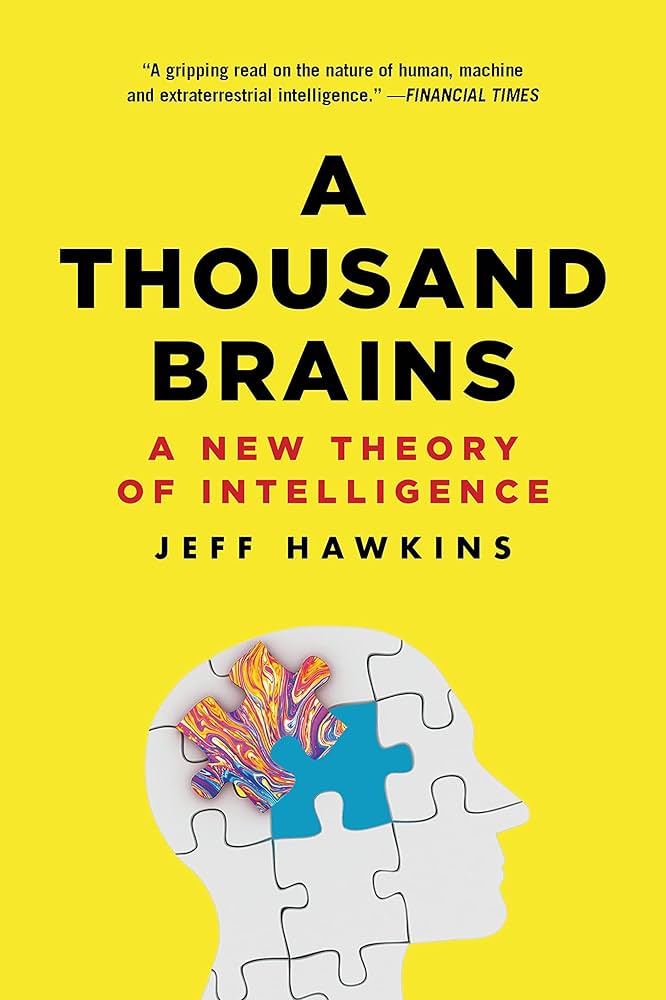
Our brain is made out of 86 billion neurons, and researchers are trying day and night to figure out how they exactly work. There are many theories, separating the brain into different parts and talking about which parts do what. This book discusses in detail the supporting evidence and implications of the hypothesis of Vernon Mountcastle. He investigated ‘cortical columns’: arguing that the neocortex is separated into small regions which all process different inputs, effectively partitioning our brain into ‘1000 different brains’ which collaboratively then build intelligent processes.
This points at the idea that at the heart of any intelligent behavior, there are the same building blocks, which are these cortical columns. This makes fundamentally all high-level cognitive functions (all kinds of perceptions, planning, high-level reasoning) actually equivalent. This is important, because it would mean that there is a common ground for all the processes which seem so different.
The hypothesis goes further, saying that we learn using reference frames and movements along those. This can be understood as learning a layout of a room: by moving around and perceiving it, one can learn a model of how things relate to one another. However, the same goes for objects, our bodies, or even abstract concepts. Jeff Hawkins argues that they are all fundamentally the same.
The later parts of the book talk about modern AI and its future development. However, the most important ideas I took from this part are about how we can and should build intelligence. We see that our own brain has been developed using evolution to a somewhat suboptimal state (think of all the possible psychological problems we have, e.g., anxieties). While building artificial intelligence for the future, we can try to avoid those pitfalls and engineer intelligence such that it does not have those deficiencies.
Overall, I enjoyed the book a lot. I got initially inspired to read it from the MLST Podcast, and I also saw that Bill Gates reviewed the book. Personally, I enjoyed the book mostly for the connection to the biology of the brain. This is the part of my Bachelor’s that I am really missing in my Master’s—these funny quirks that are maybe not so useful but still interesting.