What is Intelligence?
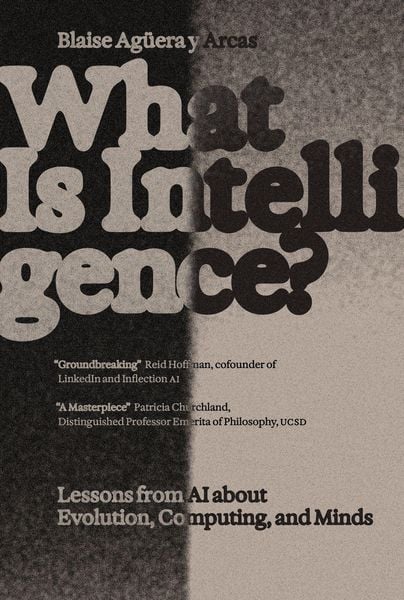
As Blaise puts it himself, this book is the Lord of the Rings to the Hobbit of “What Is Life?” book that I reviewed previously, which is pretty much contained in the first part of this book. It builds on the same core experiment, however, goes way deeper into philosophy of intelligence. It takes an own attempt at defining intelligence: the ability to predict oneself and its environment, providing utility to organism that posseses it and increasing their ability to replicate.
The core experiment in Computational Life shows a primitive form of abiogenesis: creating life from non-life in a simple computational and programming environment. This leads Blaise to conclude, that in some way appearance of life is inevitable in a computational environment. He compares our world to a computer: thermodynamics provides us with an arrow of time, similarly to a computer with a sequential order to execution of instructions. We observe in this computational system the law of “dynamic stability”: anything eventually withers, but things that replicate persist as their future copies. This principle tunes its own environment, otherwise we would not see more replication.
Blaise also goes onto to reformulate the basic principle of evolution not to be specialization, but symbiosis. If an organism can co-exist with other organisms, it makes itself more dynamically stable. In this sense, computers are symbiotic to humans as they provide them with utility of processing information. This creates more wealth for humans, and more computers as a result. Another example I really enjoy is cats: they provide emotional work by being cute, which humans appreciate and feed them, resulting in more cats. This moves the discussion about intelligence from invididuals to colonies or macroorganisms, like whole nations or even planets. Our bodies can also be seen as colonies of cells and bacteria, which created a very involved way to keep themselves dynamically stable while competing for energy that enable reproduction. The brain is no more than a symbiotic organism, it provides you with thinking and gets food in return.
Given all of this, the author also does not hesitate to take the functional view of intelligence, which states that intelligence can be provided by multiple substrates. In the end, it is just a function providing utility to the replicator that has it. In this view, large language models are also a form of intelligence. This perspective offers a nice view to see other concepts discussed in artificial intelligence nowadays in a clear hierarchy: computation enables replication which leads life, furthermore to keep an entity dynamically stable, it learns to predict its own environment, which requires it to build a world model. Agency in this context can be seen as reverse causality: the ability to predict your own environment gives you a possibility to act on your own predictions, thereby altering the environment itself.
Interestingly, Blaise argues that same as in his experiments about life, the transition to intelligence has been a step change. Once an agent develops intelligence, the other agents have to develop it too to keep up, or they will not replicate. This leads us to develop intelligence to model other agents in our environment. This is supported by the finding that the size of the human brain is correlated with the size of the social group that we were able to maintain throughout evolution. Intelligence is social and is co-evolved with the environment. Consciousness is also a product of this: others model you, so you model them, so you model yourself.
Generally, I enjoyed the book a lot. I realized that there are reocurring themes in my interests: language, intelligence, logic and many others. This book surfaced many of them and that made me very happy. I also found the way Blaise writes honest and clear. I loved the way he thanked his father for buying him his first computer. He also describes him as a “complex, flawed person” and I think we all are in some sense. He says his father’s prophecy that he will live an interesting life has been self-fullfilling. That is something that I feel myself too. My parents were always proud of me and my siblings. They would often say something alongside the lines of we do not care where you go and what you do, we see you are doing interesting things and you are thinking about them, and we love seeing you grow. And look at me, I am 24 years old and I am spending my time writing my thoughts about what life even is, my siblings have wonderful lives of their own. What can I say, I am extremely grateful.